
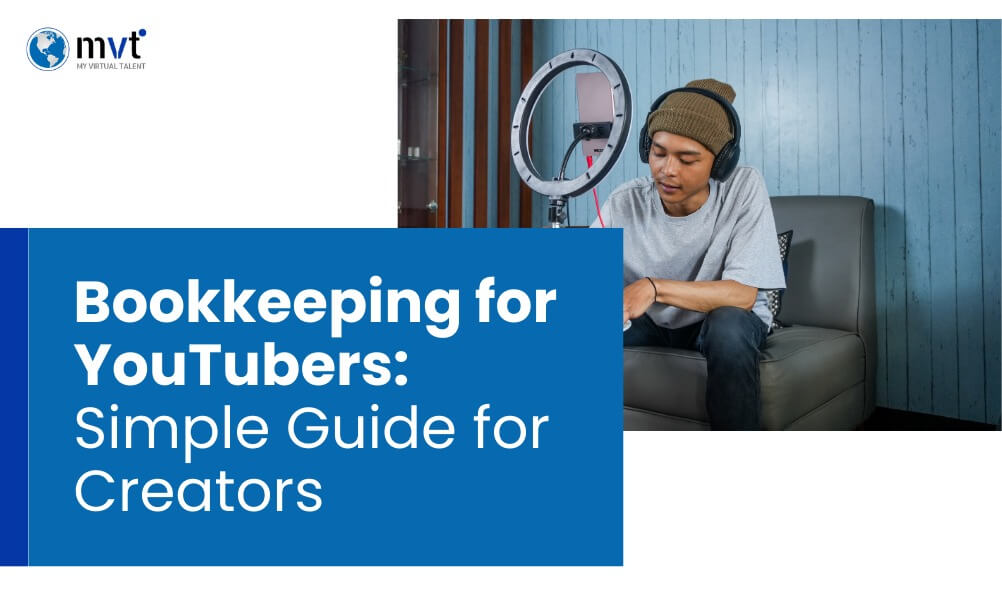
You started your YouTube channel to share your passion, tell stories, or entertain the masses not to become an expert in data entry or tax law. But as your subscriber count grows and your hobby transforms into a profession, the reality of running a media business sets in. Suddenly, you aren’t just a creator; you’re a CEO, and with that title comes the less glamorous side of the job: managing the money.
For many creative professionals, “Bookkeeping for YouTubers” sounds like a contradiction in terms. You thrive on spontaneity and creativity, while accounting demands structure and precision. The good news is that managing your creator finances doesn’t have to be a nightmare. At its core, bookkeeping is simply the story of your business told in numbers. It’s about understanding what’s coming in, what’s going out, and what you get to keep.
In this guide, we will break down everything you need to know to get your financial house in order. We’ll now cover how to separate your business and personal lives, the specific expenses every YouTuber should be tracking, how to handle taxes without panicking at all, and knowing when it’s time to outsource the headache to pros like MyVirtualTalent.
Why Bookkeeping For Youtubers Matters for Creators
It’s tempting to view your YouTube income as “extra cash” or “fun money,” especially in the early days. However, shifting your mindset from “hobbyist” to “business owner” is crucial for long-term success.
Business vs. Hobby
The difference between a hobby and a business goes far beyond how you personally view your channel. It is a formal classification used by tax authorities such as the Internal Revenue Service. If you are earning income with a genuine intention to turn a profit, the IRS considers you a business. This is exactly why Bookkeeping for YouTubers matters so much, as it becomes your strongest support in proving that status.
Clear records, separate bank accounts, and a consistent history of tracking profit and loss act as solid proof. Without this documentation, the IRS could decide your channel is a hobby, which drastically reduces the deductions you are allowed to claim and may result in an unexpectedly large tax bill.
Financial Health and Strategy
Staying compliant is only part of the picture. Strong financial management gives you a real-time view of how your creator business is performing. When you follow your numbers closely, you stop guessing and start making informed decisions.
Which income source is actually carrying your channel? AdSense might feel like your main driver, yet detailed records could show that affiliate links or merchandise bring in far higher margins. You may also discover that expensive, high-production videos deliver little return, while simple, low-cost formats generate the most engagement. Bookkeeping for YouTubers provides the clarity needed to invest more in what performs well and step away from what doesn’t.
Audit Proofing
Now for the part most creators worry about: audits. An audit does not automatically mean you have done something wrong, but it does mean your records will be reviewed. If the IRS questions a $3,000 camera deduction, a bank or card statement alone usually won’t be sufficient. You must show the receipt and clearly document how that purchase supports your business activity.
Keeping your books organized ensures that if you ever receive that intimidating notice, you can respond calmly and confidently instead of scrambling. Good records turn a stressful situation into a manageable administrative task.
Step 1: Separate Your Finances
If you take only one piece of advice from this entire article, let it be this: stop co-mingling your funds.
The Golden Rule
The absolute first step in professionalizing your channel is opening a separate business checking account and a dedicated business credit card. This creates a clear “financial firewall” between your personal life and your YouTube business.
The “Why”
Imagine trying to do your taxes at the end of the year. You pull up your personal bank statement, and it’s a mess of transactions: a Starbucks run, a grocery bill, a new lens purchase, a Netflix subscription, a deposit from Google, a check from Grandma. trying to untangle which expenses are business-related and which are personal is a recipe for disaster. You will inevitably miss deductible expenses (costing you money) or accidentally claim personal expenses (risking penalties).
When you have a dedicated business account, the logic is simple: if it’s in this account, it’s for the business. This singular step saves you countless hours of administrative agony and makes bookkeeping for youtubers infinitely easier.
Action Item: Your Business Banking Checklist
- Get an EIN: You can apply for an Employer Identification Number (EIN) for free on the IRS website. Even if you are a sole proprietor, using an EIN instead of your Social Security Number helps protect your identity.
- Choose a Bank: Look for banks that offer low-fee business checking accounts. Many online-first banks cater specifically to freelancers and digital entrepreneurs.
- Update Payment Info: Once the account is open, immediately log in to AdSense, Amazon Associates, and any brand partner portals to update your direct deposit information. All income must flow into this new bucket.
- Dedicate a Card: Open a business credit card or designate one specific personal card solely for business use until you can qualify for a business line of credit.
Step 2: Tracking Income and Expenses
Once your accounts are separate, you need a system to track the flow of money.
Income Streams
For a modern creator, income rarely comes from a single source. You need to categorize these streams separately to understand your business model.
- AdSense: This is often passive, arriving once a month.
- Sponsorships/Brand Deals: These require active management. You need to track when you sent the invoice, when payment is due, and follow up on late payments.
- Merchandise: If you sell direct-to-consumer, you have a whole new layer of complexity involving cost of goods sold (COGS) and shipping.
- Affiliate Income: Money from Amazon Associates or software referral programs.
- Fan Funding: Patreon, Ko-fi, or YouTube Memberships.
Expense Categories
Unlike a standard office job where overhead is paid by the company, you are the company. However, the “Creator Economy” has unique expenses that generic accounting software might not prompt you to track.
Hardware and Gear
This is the most obvious category. Cameras, lenses, tripods, lighting rigs, microphones, and high-performance computers are all deductible. However, be careful with “dual-use” items. If you buy a phone for “business” but use it 90% of the time for personal calls, you can only deduct the business percentage.
Software and Subscriptions
Your digital toolbox is likely extensive. Don’t forget to track:
- Creative Cloud: Adobe Creative Cloud, Final Cut Pro, or DaVinci Resolve Studio.
- Music and Assets: Subscriptions to Epidemic Sound, Artlist, or stock footage sites.
- Optimization Tools: TubeBuddy, VidIQ, or keyword research tools.
- Business Ops: Project management tools (Notion, Trello), web hosting, and domain names.
Home Office Deduction
Many YouTubers edit from a spare bedroom or a corner of their living room. You may be eligible for the home office deduction, which allows you to write off a portion of your rent/mortgage, utilities, and internet. The catch? The space must be used exclusively and regularly for business. If you edit on the dining room table where you also eat dinner, it doesn’t count. If you have a dedicated studio room, measure the square footage relative to your whole home to calculate your deduction.
Step 3: Navigating YouTuber Taxes
If bookkeeping is the daily hygiene of your business, taxes are the annual health checkup. And for creators, the diagnosis can be shocking if you aren’t prepared.
Self-Employment Tax
When you were an employee, your boss withheld Social Security and Medicare taxes from your paycheck. As a YouTuber, you are both the employer and the employee. This means you are responsible for the entire 15.3% Self-Employment Tax on top of your regular income tax. This often catches new creators off guard, leading to a much higher tax bill than expected.
Quarterly Estimated Taxes
Because no one is withholding taxes from your AdSense checks, the US tax system expects you to pay as you go. If you expect to owe more than $1,000 in taxes for the year, you are generally required to pay quarterly estimated taxes.
These payments are due four times a year (typically April, June, September, and January). Missing these payments doesn’t just mean a big bill at the end of the year; it means underpayment penalties. A good bookkeeping system will help you estimate these payments accurately so you don’t overpay (loaning the government money interest-free) or underpay (incurring fines).
You can learn more about these requirements directly from the IRS Self-Employed Individuals Tax Center.
Sales Tax Considerations
If you have expanded into selling physical merchandise, such as t-shirts, mugs, posters, you have entered the complex world of sales tax. Unlike income tax, sales tax is governed by state and local laws. You may have “nexus” (a tax presence) in states where you have a significant number of customers, requiring you to collect and remit sales tax in those jurisdictions. This is a highly technical area where professional advice is almost always necessary.
DIY vs. Outsourcing: When to Get Help
Every creator goes through a maturity curve. Knowing where you are on that curve helps you decide how to handle your books (bookkeeping for youtubers).
The DIY Stage
When you are just starting out, or if your channel is a side hustle earning a few hundred dollars a month, you can likely manage your finances yourself. A well-organized spreadsheet (Google Sheets or Excel) is often sufficient. You just need columns for Date, Description, Category, Income Amount, and Expense Amount.
As you grow, you might graduate to software like QuickBooks, Xero, or Wave. These tools connect to your bank account and automate much of the categorization.
The Scaling Stage
Eventually, you reach a tipping point. You are spending hours every month categorizing transactions, trying to figure out if a trip to VidCon is fully deductible, or stressing about depreciation schedules for your new camera.
If your hourly rate as a creator (what you could earn if you spent that hour making a video) is higher than the cost of a bookkeeper, it is time to outsource.
The Solution: MyVirtualTalent
The problem many creators face when they finally decide to hire an accountant is that traditional firms don’t understand the industry. You walk into a CPA’s office, and they look at you blankly when you ask about deducting skins for a gaming video or a trip to a collab house. They might aggressively disallow valid expenses because they view your career as a “hobby.”
This is where MyVirtualTalent shines. We specialize in bookkeeping for YouTubers and the creator economy. We understand that a gaming chair isn’t furniture; it’s a set piece. We know that the travel costs for a collaboration are a marketing expense.
Partnering with a specialist means:
- Compliance: We keep you on the right side of the IRS.
- Time Savings: You get 5-10 hours of your life back every month.
- Strategy: We provide reports that actually make sense to a creator, helping you see where your profit is coming from.
Conclusion
Building a successful YouTube channel requires a massive amount of creativity, consistency, and resilience. But sustaining that success requires business acumen. Treating your channel like a business isn’t about sucking the fun out of it; it’s about building a foundation that supports your art for the long haul.
Mastering your money gives you the ultimate creative freedom. It means you aren’t creating videos just to pay a surprise tax bill. It means you can invest confidently in better gear or new projects because you know exactly how much cash you have available.
Don’t let the numbers scare you. Start today by separating your accounts and organizing your receipts. And when you are ready to stop playing CFO and get back to being a CEO, Contact MyVirtualTalent. Let us handle the spreadsheets so you can focus on the streams.

Looking for fresh content?
Get articles and insights from our weekly newsletter.
Recent Posts









Reduce Your Marketing Spend By 70% And Grow Your Revenue Organically 10X Faster!
Get a Free Quote Today!