
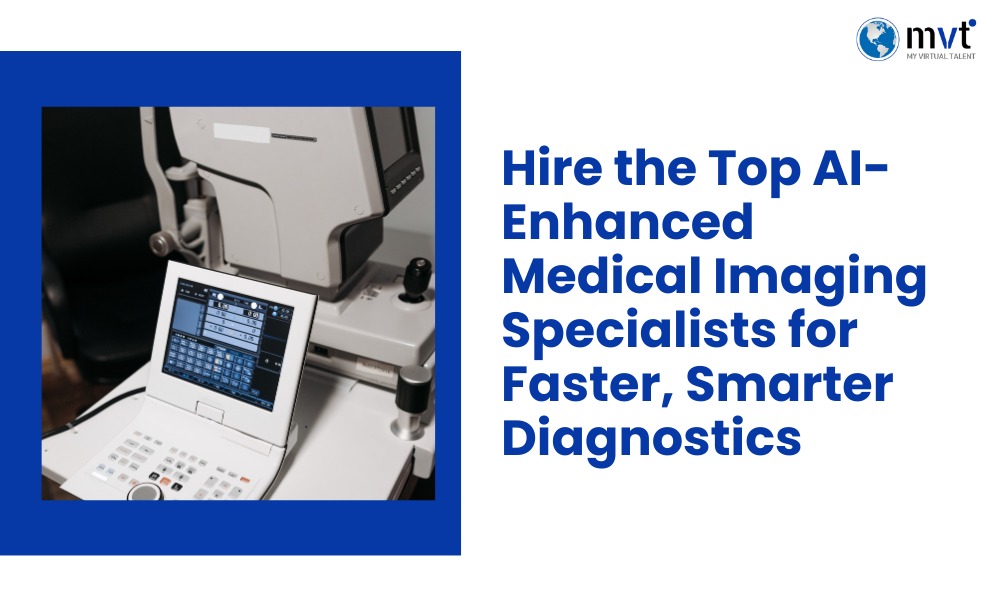
The healthcare landscape is undergoing a seismic shift. We are moving rapidly from an era of reactive, static analysis to a future defined by dynamic, data-driven diagnostics. At the heart of this transformation is the explosion of data; modern medical facilities generate petabytes of imaging data annually, from high-resolution MRIs to complex CT scans. While this data holds the key to early detection and personalized treatment, it presents a massive logistical challenge: the sheer volume is too great for traditional workflows to handle without inducing provider burnout or risking diagnostic errors.
To navigate this new reality, forward-thinking healthcare providers are turning to a specialized class of professionals: AI-Enhanced Medical Imaging Specialists.
These are not just technicians or radiologists in the traditional sense. They are experts who bridge the critical gap between clinical expertise and advanced artificial intelligence. By integrating AI tools into their daily workflow, these specialists are redefining what is possible in patient care, ensuring that the technology acts as a powerful lever for human judgment rather than a source of confusion.
This guide explores the evolution of this vital role, the specific operational and clinical benefits they bring to healthcare providers, the essential skills you must look for, and a roadmap for finding top-tier talent in a competitive niche market.
The Evolution of Radiology and Imaging
To understand the necessity of the AI-Enhanced Medical Imaging Specialist, we must first look at how the field has evolved. Radiology has always been a technology-dependent discipline, but the nature of that technology has changed dramatically.
From Analog to Algorithms
Decades ago, the transition from analog film to digital systems (PACS) revolutionized storage and access. However, the fundamental task remained the same: a human expert visually inspecting an image to identify anomalies. Today, we have entered the third phase of this evolution, the era of AI-integrated workflows.
Medical Imaging AI does not simply store images; it interrogates them. Advanced algorithms can now detect anomalies pixel-by-pixel, measure tumor growth with mathematical precision, and prioritize critical cases based on urgency. For example, AI can flag a potential intracranial hemorrhage in a CT scan within seconds of image acquisition, moving that patient to the top of the radiologist’s worklist.
The “Human-in-the-Loop” Necessity
Despite these advancements, the narrative that “AI will replace radiologists” has proven false. Instead, the industry has adopted a “human-in-the-loop” approach. AI is exceptional at pattern recognition and quantification, but it lacks clinical context, empathy, and the ability to discern subtle artifacts that might mimic pathology.
This is where the AI-assisted radiologist or specialist becomes indispensable. They serve as the conductor of this technological orchestra, ensuring that the algorithmic output is verified, contextualized, and applied correctly to patient care.
What is an AI-Enhanced Medical Imaging Specialist?
An AI-Enhanced Medical Imaging Specialist is a professional who possesses dual competency. They hold the foundational clinical certification and expertise of a traditional radiologist or imaging technologist (specializing in modalities like MRI, CT, Ultrasound, or X-ray), but they possess an additional layer of proficiency in imaging informatics and AI utilization.
Key Responsibilities
The day-to-day responsibilities of this role extend far beyond image acquisition and interpretation. They include:
- Validating AI Flags: AI algorithms are tuned for high sensitivity to avoid missing disease, which often leads to false positives. The specialist must review these flags to distinguish between true pathology and noise, preventing unnecessary anxiety and testing for the patient.
- Triaging Urgent Cases: These specialists utilize AI tools to sort through high volumes of scans, identifying life-threatening conditions that require immediate physician intervention.
- Model Feedback and Training: In many advanced settings, these specialists contribute to the continuous improvement of machine learning models. By accepting or rejecting AI suggestions, they provide the “ground truth” data that retrains the algorithm to be more accurate over time.
- Workflow Integration: They ensure that AI tools are actually saving time rather than creating bottlenecks, customizing the interface to display relevant data without cluttering the diagnostic view.
The Efficiency Gap
The difference between a standard technician and an AI-enhanced specialist is measured in efficiency and accuracy. A standard technician may process scans sequentially, potentially reaching a critical diagnosis hours after the scan was taken. An AI-enhanced specialist, leveraging automated prioritization tools, addresses the most critical patient first, ensuring that the technology serves the patient’s timeline, not the other way around.
Top Benefits of Hiring AI-Enhanced Medical Imaging Specialists
For healthcare administrators and practice managers, the decision to hire specialists proficient in Medical Imaging AI is not just about keeping up with trends; it is a strategic operational investment.
Improved Diagnostic Accuracy
The combination of human and machine, often referred to as the “Centaur” model, consistently outperforms either human or AI working alone. Studies have shown that while AI helps reduce false negatives (missed diagnoses) due to fatigue, human experts are essential for reducing false positives. An AI-savvy specialist knows the limitations of the software and knows when to trust the algorithm’s “second opinion,” leading to a more robust diagnostic process.
Operational Efficiency and Volume Management
Burnout is a crisis in radiology. By handling the preliminary data analysis and quantification (such as measuring nodules or calculating ejection fractions), AI tools allow the specialist to focus purely on interpretation. This symbiosis allows facilities to handle higher caseloads without compromising quality, significantly reducing patient wait times for results.
Cost Reduction via Medical Process Outsourcing
Hiring these specialists can lead to significant downstream cost savings. Faster, more accurate diagnoses lead to fewer repeat scans and less wasted time on inconclusive findings. Furthermore, by utilizing models of Medical Process Outsourcing, facilities can access these high-level skills without the overhead associated with expanding local, full-time staff.
Better Patient Outcomes
Ultimately, the technology and the talent serve the patient. In conditions like stroke, cancer, or trauma, time is tissue. An AI-Enhanced Medical Imaging Specialist creates a faster pathway from scan to treatment plan. Early detection, facilitated by AI sensitivity and confirmed by human expertise, saves lives.
Essential Hard and Soft Skills to Look For
When reviewing resumes for Medical Imaging Specialists in this new era, the standard checklist of certifications is no longer enough. You need to probe for a specific blend of technical and cognitive skills.
Technical Proficiency
- PACS and AI Integration: Look for candidates who have experience not just with Picture Archiving and Communication Systems (PACS), but with systems that have integrated AI overlays.
- DICOM Standards: A deep understanding of Digital Imaging and Communications in Medicine (DICOM) standards is necessary to troubleshoot how AI results are displayed and stored.
- Data Literacy: Can the candidate interpret a “confidence score”? AI often provides a probability percentage alongside a finding. A qualified specialist understands statistical probability and knows how to weigh that data against clinical evidence.
Clinical Expertise
Technology cannot mask a lack of fundamental knowledge. The specialist must have a rock-solid foundation in anatomy, physiology, and pathology. They must be able to look at a scan and instinctively know if the AI’s segmentation of an organ looks anatomically correct.
Soft Skills
- Critical Thinking: This is the most important skill. The specialist must have the confidence to question the AI. Blind reliance on automation is dangerous; the ability to critically evaluate an algorithmic suggestion is vital.
- Adaptability: Medical AI is updating constantly. The ideal candidate is a lifelong learner who adapts quickly to software updates and new diagnostic modalities.
- Communication: They often act as the translator between the “black box” of the AI and the treating physician or the patient. They must be able to explain that a finding was “flagged by AI” and confirmed by review, adding a layer of assurance to the diagnosis.
The Recruitment Challenge
Despite the clear advantages, hiring these professionals is exceptionally difficult. We are currently in a “talent gap.” The adoption of AI in healthcare hardware has outpaced the training of the workforce. Universities and certification boards are catching up, but the pool of AI-assisted radiologists and technicians with practical experience is currently small.
The Verification Problem
It is challenging to verify “AI proficiency” on a resume. Many candidates may list familiarity with digital tools, but true proficiency involves practical application in a clinical setting. Hiring a candidate who claims to be AI-literate but lacks the critical thinking skills to manage false positives can lead to liability issues, inefficient workflow integration, and potential diagnostic errors.
The Cost of a Bad Hire
Bringing on staff who resist the technology or misuse it can be costly. If a specialist ignores valid AI findings due to a lack of trust in the system, the investment in the software is wasted. Conversely, if they over-rely on it without verification, patient safety is compromised.
How to Vet Candidates Effectively
To navigate this shortage and ensure you are hiring top talent, you must adjust your vetting process.
- Portfolio and Experience Review: Ask specifically about the AI algorithms they have worked with. Have they used FDA-cleared algorithms for breast cancer detection? For lung nodule quantification? Specificity here indicates genuine experience.
- Practical Assessments: Move beyond the standard interview. Provide a test scenario involving a scan with an AI overlay. Does the candidate agree with the findings? Do they catch the error where the AI mistook a bone artifact for a vessel? Watch their process.
- Certifications: Look for continuing education credits in imaging informatics or specific certifications from vendors that produce medical AI software.
Conclusion: Streamlining Your Hiring Process
The integration of AI into medical imaging is not a fad; it is the new standard of care. To remain competitive and provide the best possible outcomes for patients, healthcare providers must transition from traditional staffing models to building teams of AI-Enhanced Medical Imaging Specialists. These professionals ensure that your facility maximizes the potential of expensive diagnostic technology while maintaining the safety and nuance of human oversight.
However, finding this specialized talent is a burden that creates bottlenecks for internal HR teams. Sifting through resumes to find the needle in the haystack, the candidate with both clinical excellence and technological savvy can take months.
This is where specialized partners become your greatest asset. MyVirtualTalent is the premier solution for healthcare providers looking to bridge the talent gap immediately. We specialize in sourcing pre-vetted, top-tier professionals who are already proficient in the latest medical imaging technologies and workflows.
By leveraging Medical Process Outsourcing, you can bypass the recruitment headache and access a global pool of experts ready to integrate into your digital workflow today. Whether you need support for high-volume triage, 24/7 coverage, or specialized AI validation, our team is equipped to deliver accuracy and efficiency from day one.
Stop searching for the future of radiology on your own. Partner with MyVirtualTalent today to build a future-ready diagnostic team that scales with your needs.

Looking for fresh content?
Get articles and insights from our weekly newsletter.
Recent Posts


Reduce Your Marketing Spend By 70% And Grow Your Revenue Organically 10X Faster!
Get a Free Quote Today!